As I got more and more interested in wine, I realized I needed to hold more wines, for a number of reasons. I wanted to always have on hand the perfect wine for any occasion–that requires having at least 15 or 20 types of wine. I wanted to buy multiple bottles of age-worthy wines, and taste them at different points in their “life” to experience changes firsthand. Also, for an especially good vintage, or for a good deal, I wanted to have the option of “loading up”. All of these things required having storage capacity at home. I sensed a project! At that point, I didn’t really have an “ideal capacity” number in mind, and in truth I had limited space available anyway.
One benefit of living in an older home: it has a basement. A “quarter basement” to be exact. For years, I bought wine and just stacked cardboard boxes down there, maybe 20 or 30 bottles at any one time. It felt cool down there, so I figured it was fine. But more than once, a bottle went to vinegar. I researched, and learned a bit about wine storage. There is a wide range of opinion and judgement on what constitutes “ideal” conditions, but I relied on Wine Spectator to guide me. 7 Wine-Storage Basics You Need to Know | Wine Spectator

I got a remote thermometer/hygrometer (measuring relative humidity) and tracked the climate of my basement starting in early spring 2020. By May and June, I’d seen enough: temperatures were rising with the coming summer–60, 63, 69, 72. As bad, temperatures were varying by up to 5 degrees through the course of the day (see table). If I wanted to hold wine, my storage had to be cooler and more stable.
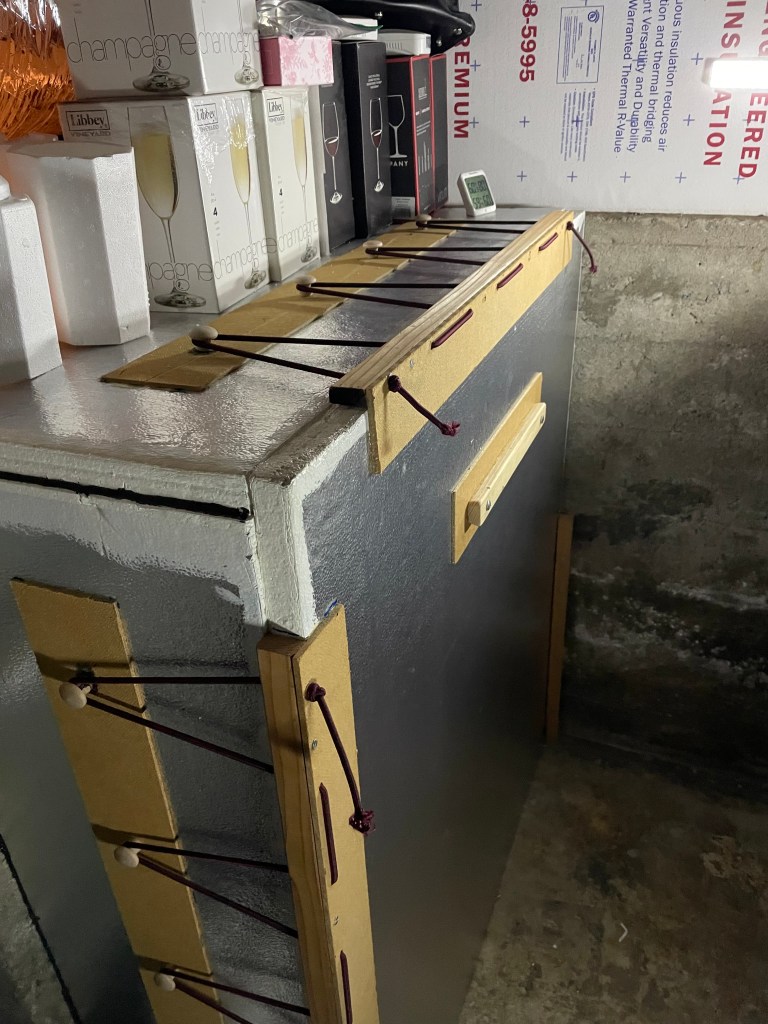
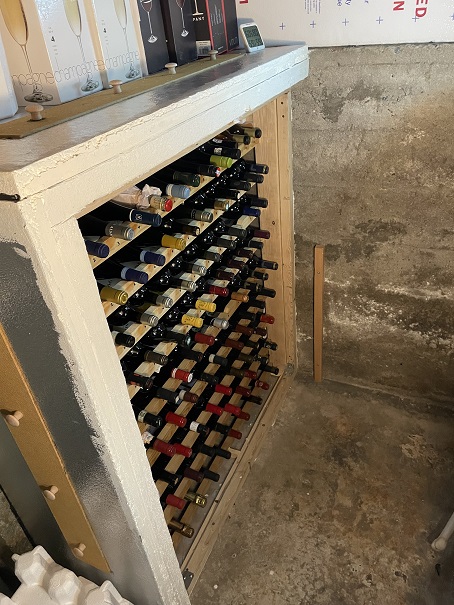
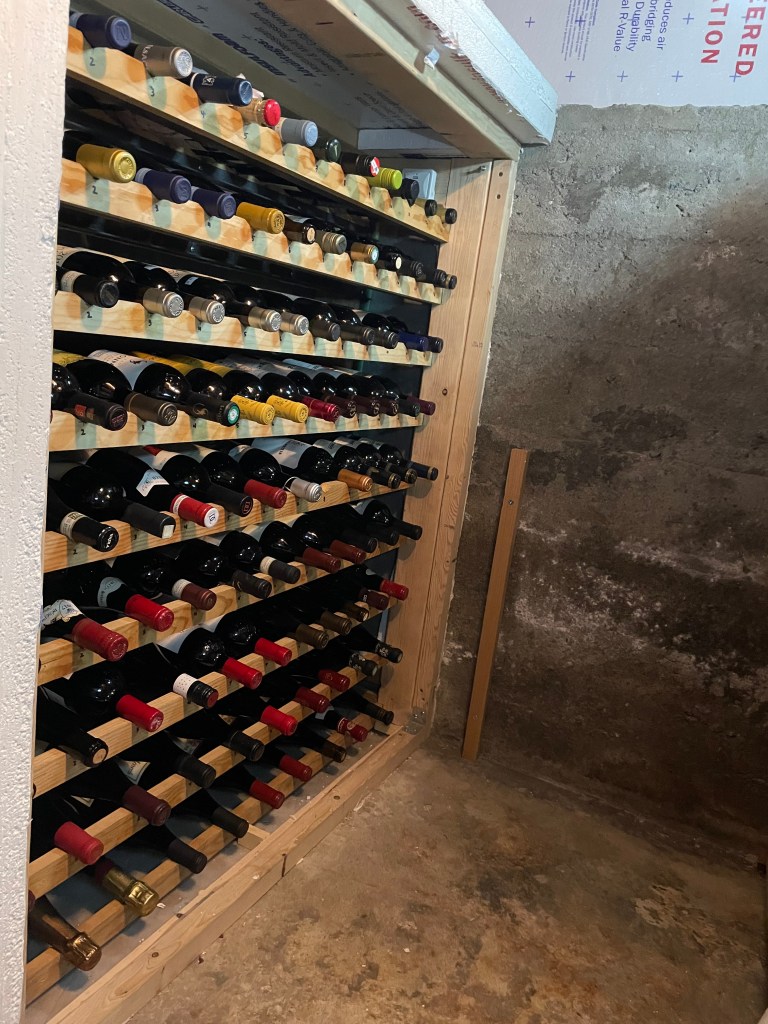
Most information out there on home wine storage, in my opinion, is biased towards one thing: getting me to buy a very expensive “active” (i.e. electrically powered refrigerator with humidity control) wine cooler. I didn’t want to spend that cash, and decided since I had a basement with “earth walls” (i.e. concrete walls in conact with the ground, and away from the outside walls of the house, which are exposed to heat), I would do a “passive” system which took advantage of the earth walls. I cleared space and gave myself a corner of the basement with two earth walls and a floor. My budget ($500) would only pay for a DIY shelf with a super-insulated box around it. I jiggered the design of the shelves to fit 103 bottles into a 4′ x 5′ space. I boxed in the shelf with 1.5″ rigid foam insulation, with a fitted “door” held in by elastic straps. Far from a glorious cellar with beautifully displayed bottles, sitting area, and lighting, mine is literally an insulated wine locker. In went the remote thermometer/hygrometer sensor. Much improved…but still too warm and a bit too much daily variation. By this time, it was mid-summer 2021. I made a series of upgrades to improve both temperature and humidity: added more rigid foam insulation to the locker; added a vapor barrier inside the locker to reduce humidity; added insulation to the outside walls of the basement to reduce heat penetration from outside; and added a small “whole house fan” to draw cool morning air into the basement.
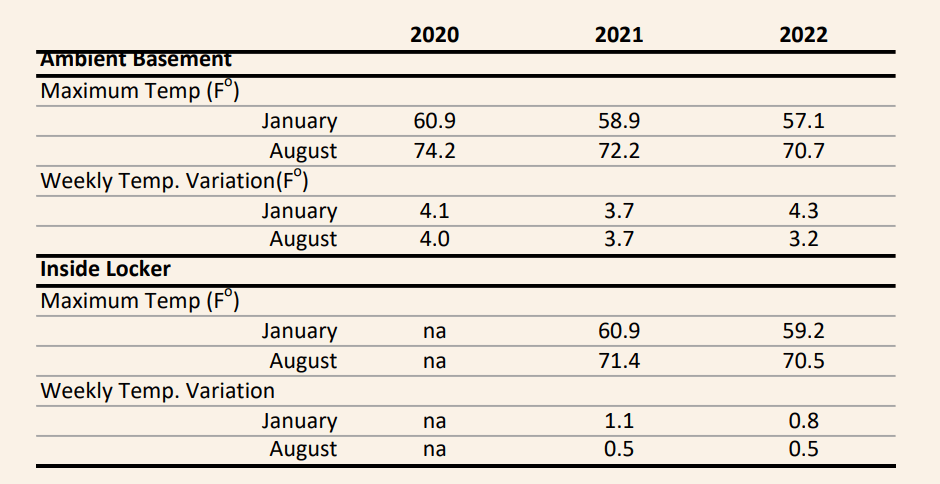
The figure below shows the results of all this. I still don’t have an ideal storage environment–temperatures inside the locker still approach 70 degrees at the peak of the summer. But daily and weekly variation in temperature is very small, less than a degree. And overall range through the seasonal changes of the year is about 59 to 70 degrees (see figure). Too hot to age wines for decades, but certainly enough to hold wines for 5 to 7 years.

I’m planning one more big change to my storage: boxing in the corner of the basement with insulated panels, and adding insulation to the one outside wall, and to the ceiling of the basement, in the storage area. This will give me more space to store everyday wines for the shorter term outside the locker, and allow me to use space inside the locker for more age-worthy wines. Paneling around the locker should reduce the temperature immediately outside the locker, which should in turn reduce the temperature inside the locker. My goal is to keep maximum temperature inside the locker to 65 degrees or less.
So having long term storage achieved the goals I had for it: I have an array of wines for any occasion at all times. I’m buying some age-worthy wines now (most Rhones, Bordeaux’s, and CA and OR pinots), and buying multiple bottles to taste over time. And, when a deal or a great vintage comes up, I can load up. But, having long term storage has changed how I drink and enjoy wine, too. I have to track wines now. I use a DIY excel spreadsheet for this, it’s great. I always know what I have, and what wines I should be drinking now as opposed to holding. I can keep track of the variety of wines, and identify “holes” in my inventory–so my wine buys are more targeted now. Finally, and most importantly, I can keep my wine notes, as well as expert reviews of the wines I have drunk–I will dive deeper into that in the #5 Post.


 Talented Amateur