I am shifting the focus of this blog from wine scores to tasting, and alternatives to scores as a guide for learning about (and purchasing) wine. But…I was curious about Wine Advocate as a source of reviews and scores. I did not include WA in the initial work I did on scores. WA is interesting for a few reasons. WA was created by Robert Parker. Parker is famous (infamous?) for creating the 100-point scoring system, among other things. WA is run on a paid-subscription model, with no advertising, so the commercial pressure to raise ad revenues by giving high scores is, in theory, absent. WA wine tastings for reviews are usually not blind, and they go to great lengths to explain why blind tastings are both unnecessary (because the no-advertising model takes away the major reason for blind tasting) and inferior (because knowing the winemaker….hmmm….I actually did not follow the logic of this part of the explanation, maybe you can: The Wine Advocate Reports & Reviews – Robert Parker Wine Advocate).
Before diving into some of the data, I should acknowledge and commend both WA and Wine Spectator for allowing subscribers to tap into their vast database of wines with useful and powerful query and filtering tools. Wine Enthusiast and Vivino do not support this sort of independent access to their data.
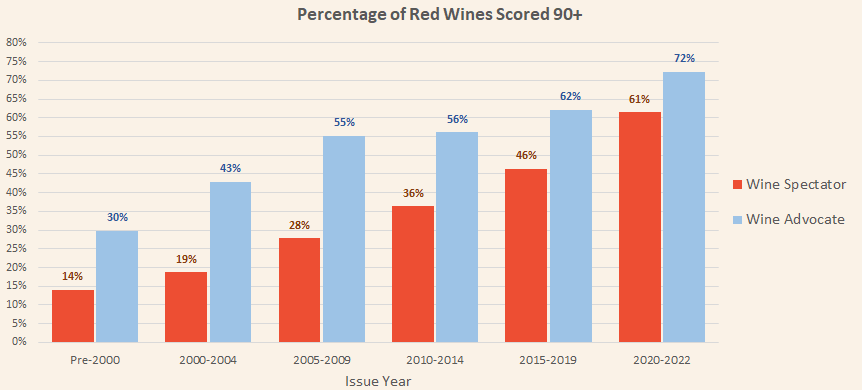
The dramatically increasing prevalence of 90+ point scores in WA reviews is different from WS only in degree. In the last three full years (2020 through 2022), WA rated 72 percent of the red wines they reviewed 90 points or higher, compared to 61 percent for WS. WA has consistently been higher than WS in this measure over the years, too. WA rated 90+ for 30 percent of the wines they reviewed prior to 2000, compared to 14 percent for WS.
Initially I was surprised to see WA right there with WS on score inflation, because I thought that advertising was the biggest factor causing it. One factor I had not thought about prior, though, was self-selection. All of the expert-review platforms depend on winemakers to contribute and ship wines, at their cost, to the reviewers. Each platform gives somewhat vague descriptions about how this works. WA and WS mention buying selected wines to review, but do not specify what percentage of the reviewed wines are purchased, rather than contributed by the winemaker. I asked for clarification on this point. WA was cagey in their reply but reading between the lines, wines purchased for review are a slim minority of cases. WS has not replied. I am left to assume the vast majority of wines reviewed are contributed by the winemakers.
Question: For how many years would a rational winemaker continue to contribute their wines for review, if the reviews they got were not great? I have noticed on all three of the big expert-review platforms (WS, WA, WE) many incidences of a wine being reviewed for several years in a row, then disappearing entirely. I always assumed it was the reviewer that lost interest and stopped reviewing the wine. That may be true in some cases. WA strongly asserts that selection of the wines to be reviewed is totally up to the expert reviewer. I bet in a lot of incidences, it is the winemaker that loses interest and simply stops sending in their wines. This creates an echo chamber of wines that are well reviewed, and therefore are more likely to be offered up by the winemaker for review in the upcoming year. The continuance of well-reviewed wines, and the resignation of poorly-reviewed wines, must account for some of the increase in aggregate scores: if the consistently highly-rated wines stay in the echo chamber, and the not-so-highly-rated wines leave the chamber never to return, aggregate scores would increase over time through winnowing.
The echo chamber really is a chamber, rebuffing many of those on the outside. Paul Gregutt did a nice piece on this recently (Not Rated: The Wines Outside the System). There are many, many worthy wines that never break into the echo chamber of expert reviews by the big platforms.
I still do believe that some level of true score inflation is occurring. I have tried too many supposed 90+ point wines that just are not that special. I won’t use the word corrupt, but the system does seem rotten and bloated to me. I will continue to pay very guarded attention to scores, from reviewers I trust. But I will be exploring other ways to learn about, and purchase, good wines. Specifically, I’ll be looking at:
- Wine retailers–the smaller ones, that actually have knowledgeable sales-people. I am blessed to live about a mile from Corti Brothers grocery store, which has a storied and very comprehensive wine shop. If you have not read this LA Times article on Darrell Corti, you should. I have purchased many bottles from Corti Brothers, but usually ones I drink that night or that week. I have not purchased many ageable bottles from Corti, but moving forward will compare the wines and prices I can get there to what I have been getting from online sellers.
- Wine brokers–a very knowledgeable, wine-loving friend of mine purchases a significant portion of his wines from a broker. Brokers generally negotiate for blocks of wine from producers they are familiar with, but are either impossible or very difficult to find in the usual retail or online sellers. Over time, brokers also learn the preferences of their clients, and recommend wines likely to suit their tastes. I’ll be making a couple of buys from a broker, and test whether the wines I get are better than the ones I have been getting on my own.
- Direct buys from wineries–wineries are the one place that you can taste the wine before you buy, and completely follow your own palate. That said, I have experienced the “winery effect”: I go to wineries for a fun, relaxing day out, usually in a scenic location. All that influences my mood and my palate on that day. More than once, I have purchased a few bottles I loved at the winery, only to get a “what was I thinking?” feeling when I try those wines at home under normal conditions. Still, I believe finding a few local wineries whose wines I enjoy, and supporting them through my purchases, will be worthwhile.
- Alternative wine reviewers, who de-emphasize scores. The blogosphere and youtube are riddled with thousands wine reviewers…the problem is finding a few that actually align with my tastes. Plus, finding the recommended wines is often very difficult with the alternative reviewers, without ordering direct from a winemaker. I will make the effort, though, and see how it works out.
One source I have not mentioned and will not be exploring is wine clubs. I’ve tried them at various times, and they are just not for me. I have tried both the winery clubs, and the distributor clubs, where the club sends out wines from multiple sources. Some people swear by them. Not me–maybe I have trust issues?


 Talented Amateur