The first blind tasting is in the books now, and it was a really fun and satisfying experience for me. I hope it was for the other six tasters. This post will provide the results of the tasting, and some thoughts about how to organize future tastings for this blog.
(Note: the invititation to this tasting went out in late February to all subscribers…contact me at talentedamateur.bg@gmail.com if you did not receive the invitiation).
The Wines
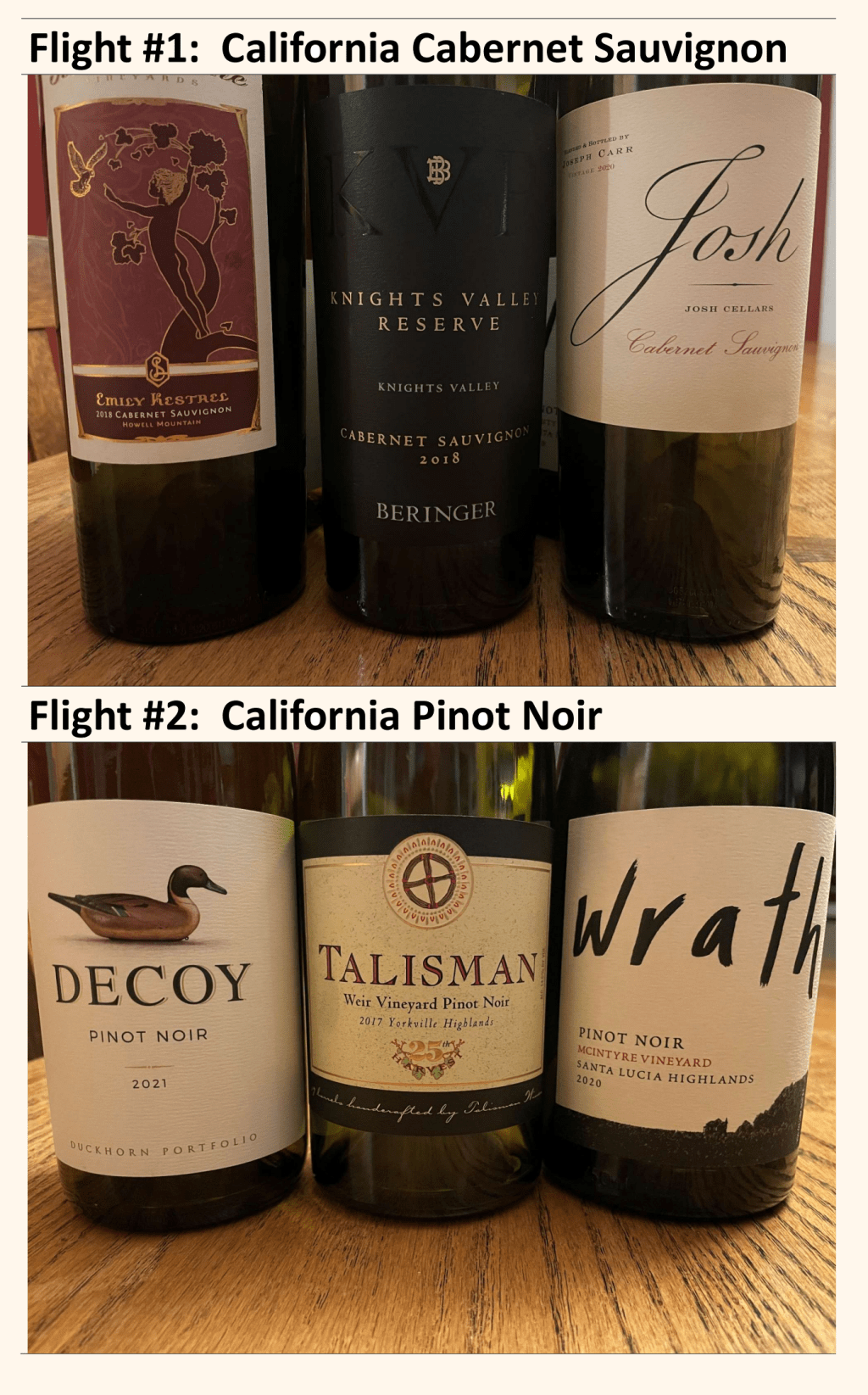
The tasting included two flights of three wines each, for a total of six wines. The first flight was cabernet sauvignon, the second was pinot noir. All were from California. TA subscriber Ted C contributed two wines for the tasting (1A, 2B)–thank you! The other wines were contributed by TA.
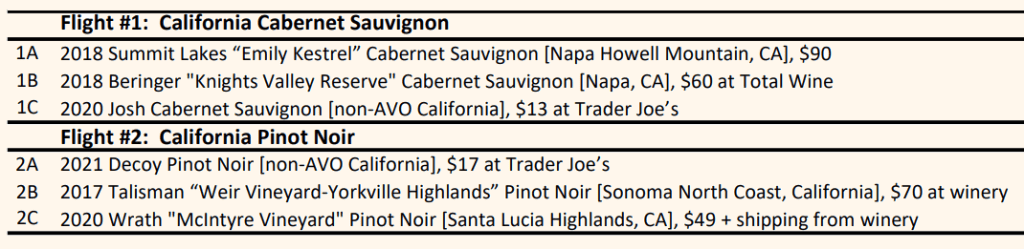
- Two wines were included in part because of widely divergent expert reviewer scores–the blind tasting was intended to “settle the score”.
- 1B (’18 Beringer CS): WS 87, WE 92
- 2C (’20 Wrath PN): WS 89, WE 94
- Two “value” wines were included to provide a point of reference for the other, pricier wines (the so-called “Trader Joe’s test”).
- 1C (Josh CS): $13 compared to $60 and $90 for the other to cabernet sauvignons
- 2A (Decoy PN): $17 compared to $49 and $70 for the other pinot noirs
Format of the 3/26/2023 Tasting
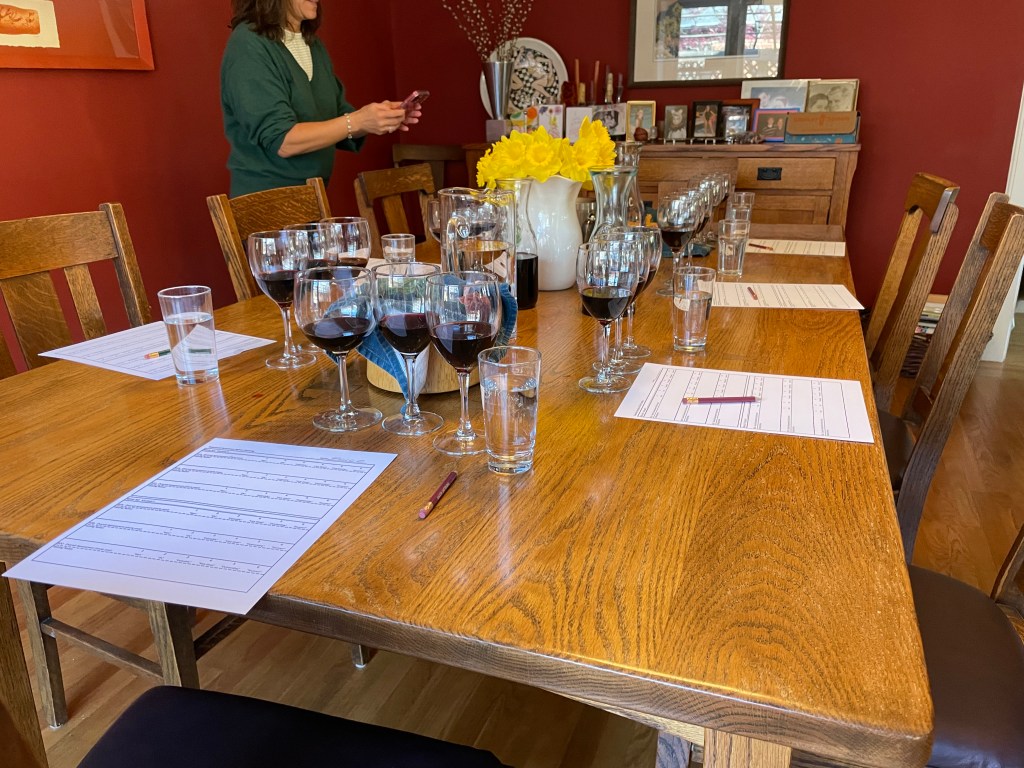
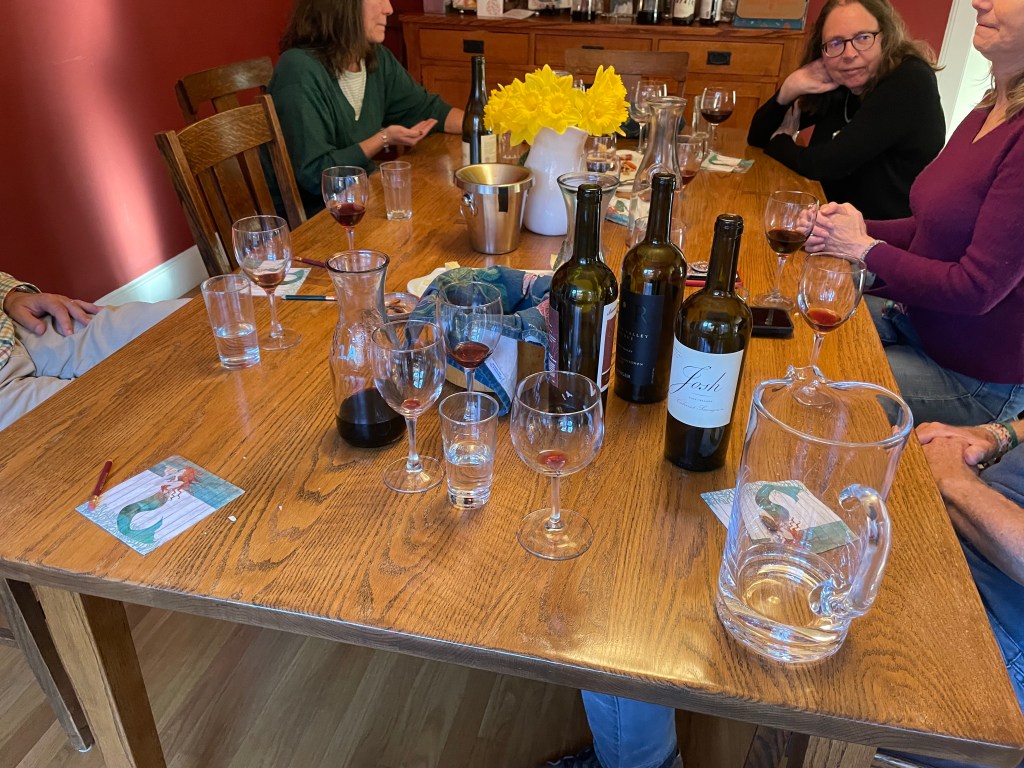
The wines were all uncorked two hours before the tasting, and carafed one hour before. Each taster was provided with three glasses to taste, a form for recording their tasting notes and overall assessment of the wine, and water and plain baguette slices for palate-clearing. The tasting of each flight started with a “quiet phase” of about 15 minutes, during which tasters were requested to minimize conversation and focus on tasting the wines and recording their assessments. All tasters knew that one flight would be cabernet sauvignon and the other would be pinot noir, but no taster knew which flight was which. After all the tasters had completed recording their assessments, each taster shared their overall assessment and their tasting notes with the group. The tasting of both flights was completed in about an hour, after which wine-friendly food was served and the remains of all the wines were available for re-tasting. All tasters had a chance to revise their assessments and tasting notes throughout the event.
RESULTS
The scoring system was a simple, largely qualitative system devised by TA:
- 1–“Meh”
- 2–“OK”
- 3–“Enjoyable”
- 4–“Very good”
- 5–“Outstanding”
- 6–“Stunner”
The table below shows the taster ratings for each wine, with averages by wine and by taster. The shading is green = high, red = low.
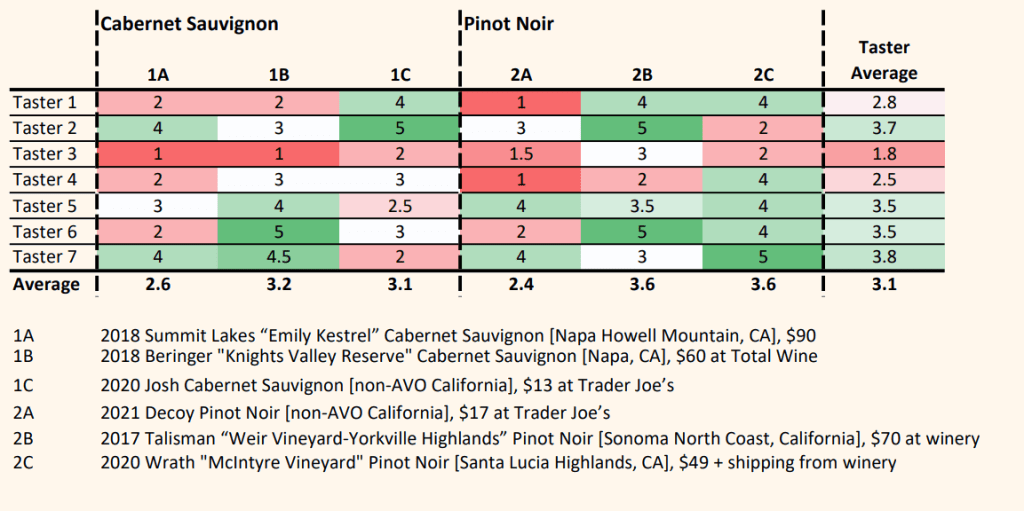
Not pulling any punches here, the taster ratings were all over the map, and the average ratings are really almost meaningless. Highlights as I saw them are listed below, with my own comments on the wines [in brackets and italics]:
- No “stunners” in the flights. Most tasters found at least one wine they rated “very good” or better. But nobody had their socks knocked off by any wine. Hopefully some 6’s will be posted in the next one!
- If there was a “crowdpleaser” it was 2B (’17 Talisman PN). The wine had several tasters rating it very good or outstanding, and only one taster found it less than enjoyable.
- [I found the wine just enjoyable, with raspberry aromas and a bit of smoke and spice, but wanted a longer finish].
- Love it or hate it. Several of the wines fell into this category, with tasters either really liking, or not thinking much of it. The first two listed wines were also widely divergent on the expert scores–maybe it is not that surprising we amateurs also could not agree!
- 2C (’20 Wrath PN) was probably the best example of this, with four tasters really liking (very good to outstanding) and two thinking it’s just OK. This one also had the most tasting notes in common (red fruits, leather, tea).
- [I liked this one, it had some power and complexity, with both red fruit and earthy aromas and flavors, and long-finishing].
- 1B (’18 Beringer CS) was another good example of a polarizing wine, with three tasters finding it very-good-to-outstanding, and two finding barely OK. This one had two tasters thinking it was a Bordeaux, and two remarking on its long finish.
- [I also liked this one, I can understand the Bordeaux comments. It had a strong plum/dark fruit base but also floral aromas, fennel, and even a touch of bell pepper. I found it bright, with a bit of acid and tannin, too. I’m not sure it’s worth $60, but I enjoyed this one very much].
- 1C (’20 Josh CS) had a lot of oak-induced aromas and flavors (clove, carmel) that showed up in tasting notes. This really appealed to some tasters.
- [I was in the other camp, not caring for this one at all–it got a charitable “OK” from me. “Oak popsicle” was one of my tasting notes–I’m OK with a little oak in a wine, especially a red wine, but this one was way out of balance in my opinion.]
- 2C (’20 Wrath PN) was probably the best example of this, with four tasters really liking (very good to outstanding) and two thinking it’s just OK. This one also had the most tasting notes in common (red fruits, leather, tea).
Settling the Scores
The takeaway from this tasting is if there are widely divergent scores among the experts, go with the lower score.
- For 1B (’18 Beringer CS), two taster ratings (4.5 & 5) aligned better with the higher score (WE 92), and the remaining five (ranging from 1 to 3) aligned better with the lower score (WS 87), or worse.
- [I was one of the two high ratings–if I was forced to rate the wine on a 100 point scale, I would put it at 90].
- For 2C (’20 Wrath PN), six of seven taster ratings (1 to 4) aligned better with the lower score (WS 89), and only one (5) with the upper (WE 94).
- [I was the high end of this one–again, if forced, I would rate it 92 on a 100 point scale].
Trader Joe’s Test
The test question here is “Does a value wine you can get at TJ’s stand up to the pricier wine?” for a taster. The results split on this one–for the cabernet sauvignon, 1C (’20 Josh CS) did stand up to the pricier ones. Not so for 2A (’21 Decoy PN).
- 1C (’20 Josh CS) was rated highest among the cabernet sauvignons for four of the seven tasters, and another taster put it between the other two cabernet sauvignons. Only two put it as the lowest among the cabernet sauvignons.
- [I was one of the two who put 1C well below the others, for reasons I mentioned above. I have not tried many of the Josh wines, the few I have were OK–I would judge this one as barely OK].
- 2A (’21 Decoy PN) was rated the lowest among the pinot noirs by four of the seven tasters, in the middle of the three by another two. Only one taster rated it the highest among the three.
- [I was the one of the two putting 1C in the middle of the three. My experience with Decoy, in general, is they are reliably drinkable and a safe bet for a value wine. I liked the strawberry fruit aroma I got from this one, and appreciated the longish finish].
Blind Tastings Moving Forward
Not planning any really big changes. I did a brief survey of those who made it to this one, and will make a couple of minor changes for future tastings based on that input:
- Preference to have more of a “theme” for future tastings. Examples of possible themes are “Red blends less than $30” or “My favorite Oregon pinot noir”. This approach will have to be blended in with some of the issues of interest on this blog. For example, I will include a “TJ test” element in at least some of the future tastings.
- Preference to have more tasters putting wines they have selected into the mix. I think some tasters would: 1) like to contribute to the wines tasting just to share the burden a bit; 2) find out how a favorite wine of theirs measures up other wines; and 3) see if they can identify “their” wine from a group of other wines.
- Request to have some orientation and resources to help tasters feel more comfortable with what they are being asked to do in the tasting. I’m investigating a couple of options for doing this for future tastings–there are some great online resources, and at a minimum, I will send those out in advance of the next tasting. Suggestions welcome on this!


 Talented Amateur