
<<Recommend reading this one on a laptop–main table is too small to see on a phone.>>
I have been very curious about how wine prices at brick & mortar stores compared to online retailers for a while now. Let me start by saying, its pretty much impossible to do this in any real sense–the variation in product offerings, complicated discounts, memberships, coupons, etc. work against doing a true comparison. I finally figured an approach to comparing pricing (mainly), and the range of wine offered (secondarily). I had to simplify to make this work, and I admit up front that this analysis is far from perfect or definitive.
For purposes of this post, both “brick & mortar” and “online” only included high volume retailers, not boutiques. Brick & mortar include two supermarkets (Raley’s and Safeway) and two big volume retailers (Total Wine and BevMo). I added direct buys from wineries into this mix, purely to see how winery prices compared. So a total of five sources. Notably absent from brick & mortar are outlets like Corti Brothers, Trader Joes, and Costco. Unfortunately, these stores do not have inventory information available on line, and I am currently in COVID isolation, so could not visit the stores in person. Plus…this one has taken a lot of time so far, and I am anxious to get this post done.
The online retailers included Total Wine, Vivino, Wine.com, K & L Wines and Vine & Cellar (Safeway’s recent entry into the online wine market), plus two other online sources: the wineries themselves, and another source that needs a bit of discussion. Vivino sells wines on their website or app, but almost all of those sales are brokered from other “real” wine distributors. So, for all Vivino purchases, I also included the price if I went directly to the distributor instead of Vivino. So a total of seven online sources, but two of the seven (wineries, and the Vivino “direct buy” vendors) were in fact multiple sources.
The approach I took was to create a sample list of 24 wines to “shop” for at all of the retailers, and assemble price data on the wines to compare. No list would be “common to all” vendors, but the list I assembled leans toward wines in wide circulation. On average, I found the sample wines in about eight of the 12 sources, but the actual number ranged from a low of four sources to a high of 12. This list is biased to my own tastes–all of the wines on the list were ones that I have actually purchased in the last couple of years, or might in the next couple. There are few budget or value wines on the list (e.g. J. Lohr cabernet sauvignon or Seghesio zinfandel), but there are also some “reach” wines, too. At your average supermarket display, the wines on this list are at eye level or above😘.

Stating the obvious here, one major difference between brick & mortar and online wine buying is shipping to my home address. With brick & mortar, that cost is near zero: I transport the wine from the store to my house. With online, I am paying the cost of shipping the wine from the warehouse to my house, and those costs are significant. The chart below shows the average shipping costs from the seven online vendors for orders consisting of one to six bottles. Obviously, buying one bottle and having it shipped is extremely expensive. But even with an order of six bottles, average shipping cost per bottle is $3.56. So, online retailers bottle prices need to be that much lower to compete with brick & mortars.
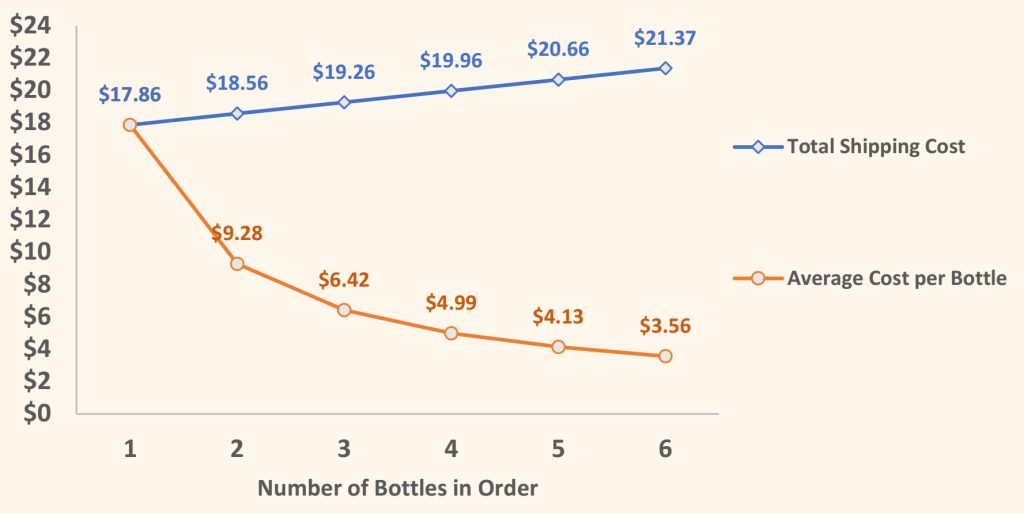
Some online vendors have shipping deals and discounts. Vivino, for example, ships free if your order is $200 or more. Wine.com offers a club: if you pay $49 to join, you get free shipping on all orders for the next 12 months. The graph above does not reflect these sorts of discounts and clubs. The prices shared in the cost comparison table (presented below) DO include the Vivino free shipping where the order would be greater than $200, and for Wine.com, I factored down the cost of shipping to reflect likely use of their club over the course of the year.
A couple of final geeky details: I had to pick what prices to compare, in part because some of the vendors offer multi-bottle discounts, and part because of the aforementioned issue of shipping costs. I compared prices for 6-bottle purchases at each retailer, so the bottle prices reflect multi-bottle discounts where offered. The prices are fully loaded, with tax and shipping. I calculated what I called the “best average” from all retailers for each wine, and the table below shows how each retailer’s bottle price varies from that “best average”, with red shading above average and green shading below.
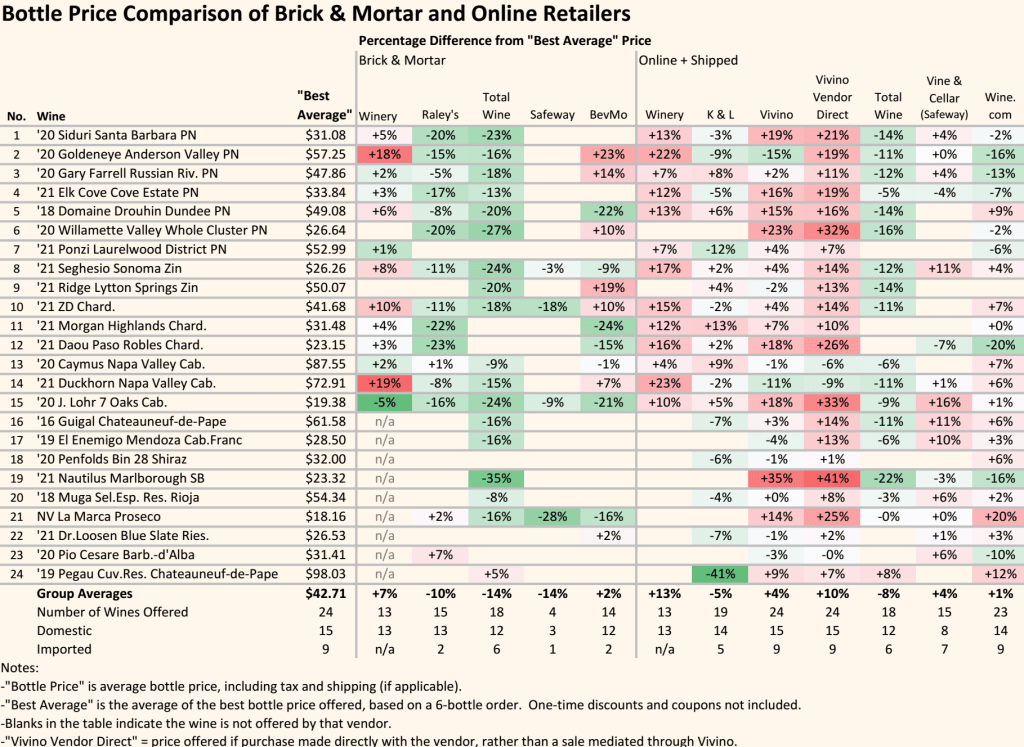
In the table above, the “Group Averages” row calculations had to account for the fact that a different set of wines was offered by each retailer. So each retailer average price is compared to the “best average” price of just the wines they offer. So the four Safeway brick & mortar wines were 14% lower than the average of the “best average” prices for those same four wines. Hopefully that makes sense.
Takeaways
At the highest level, the main takeaway is the big brick & mortar retailers are where you will find the best prices, if you can find what you want.
Another big takeaway: if you order wines online, buy at least four bottles, if not more. Buying one bottle and shipping it is horribly expensive.
Specific takeaways on vendors and some advice (including advice not related to prices):
Total Wine–both brick & mortar and online, Total Wine had a pretty good combination of lower prices and good selection, based on my (biased) list. I guess this is not surprising…but I always find shopping blind at Total Wine depressing, simply because in the vast array of wines (literally thousands in their stores), I recognize literally a dozen or two. The staff recommendations in my experience are useless, or worse. My favorite way of shopping there is to research what I want online, and go to the store to pick those wines up, with maybe a pass through a couple of aisles to fill out a multi-bottle discount with some tried-and-true value wines. Two big gripes on Total Wine: I sometimes find out some of the wines I picked do not qualify for multi-bottle discounts when I got to the checkout; online inventories often shield the vintage of a wine, and you have to go to the store to find out.
Raley’s–easily my favorite supermarket retailer, Raley’s is good on prices, and on selection of domestic wines. They are weak on imports. Two pieces of advice: 1) IGNORE the single bottle prices–they are a behavioral economics trick to make you feel good about getting either the member discount (usually pretty small) or the six-bottle discount; and 2) only go in planning to buy six bottles or more. I would describe the six-bottle prices as about a 10 percent “real” discount, not the 30 percent discount they claim.
Safeway–I was surprised at how few of the wines on my list could be found at my local Safeway store. Those that were offered (only four of the 24!) were well priced. Safeway now has an online wine retailer called “Vine & Cellar” which was surprisingly good on selection (15 of the 24) and not horrible on price. If I was bothering to buy online, though, there are better options.
BevMo–I will not go there for wine any more. Their basic prices are erratic and high on average, and their selection is weak on imports. Also, I noticed that some of the wines on my list were a couple of years older than the one I was looking for, which might be great if their storage is good–I am a skeptic on that topic. BevMo also does online, but I just ran out of energy and did look at their pricing. BevMo, like Total Wine, shields the vintage on some of their offerings online.
At-Winery Buys–they showed a bit high on average (no surprise) but not as much as I expected. Obviously, we go to wineries for many reasons, and if we are there and like the wine, we should buy it happily. The small wineries, especially, need the extra profit.
For all online buys–I do not order wines for shipment from about May through October, due to the hot weather here in Sacramento. (K&L Merchants actually brought this to my attention when I ordered in the summer). I avoid shipping wines from East Coast distributors, mostly because of shipping cost. But if I did, I’d avoid winter months, too.
K&L Wine Merchant is the online retailer I use most frequently. The prices are a bit below average, the selection of both domestic and imported wines is good, and they have a wide array of age-able, “reach” wines I occasionally buy. Plus they offer some other services, like holding wines for me (within reason). So, if I see a wine I want on sale, but it is only one or two bottles I am willing to buy, I can go ahead and buy it, and have it held until I find some other wines to fill out a shipment. K&L has given me good advice on shipping [e.g. that from their Bay Area warehouse, Fedex Ground (cheaper) delivers in two days to Sacramento, just like 2-day Express (more expensive)].
Vivino–based on what I see, I would never order a wine from Vivino. To start with, their prices are, on average, high. In fact, other than the wineries (no surprise!), the only “source” they beat is the direct buys from the vendors they broker for. That surprised me: you can get a wine more cheaply from Vivino than from the distributor they fronted for. (That has got to piss off the Vivino “partners”)! The difference was mostly shipping. Vivino charged a flat $20 for shipping, which was forgiven on orders greater than $200. Most of the distributors they fronted for charged more (rationally) for shipping, if I ordered directly from them. Plus, Vivino does not bundle across the distributors they front for. For example, if you want buy wine A, which in the Vivino world is from a distributor in, say, Virginia, and wine B which is offered by a distributor in Colorado, even if your total order is greater than $200, each distributor is counted separately, so you pay shipping twice: $20 for the order shipped from Maryland, and $20 for the order shipped from Colorado. The “cheapest” wines I found, in several cases, had been shipped from a California winemaker to a Virginia distributor, then back-shipped to me in California. How that makes any sense is beyond me. Finally, Vivino also did not tell you what sort of shipping you are buying–the other vendors generally give you options for shipping, and you chose. Especially if a wine is shipped across this big nation, the “how” of shipping is important.
Wine.com was a much better and, I think, a more rational online retailer than Vivino. They are big, and they do their own warehousing. They had a great array of products, and reasonable prices. I had never really looked at them seriously before, I probably will in the future.


 Talented Amateur