Many subscribers know that I was in Europe for three weeks this summer. That trip took me to the south of France, Venice, Slovenia, Croatia and Puglia. A small but important part of the trip was either devoted to wine, or was greatly enhanced by wine. Wine in Europe has the depth and complexity of an ocean, and my foray was the equivalent of a few wonderful beach days. What I have to share in this post are a few experiences and learnings from visits to wineries (plus one to an olive oil producer). The big takeaway for me was that a winery visit, olive oil tasting, or whatever food-oriented tourism, really adds a dimension to a visit to a new area, and it is worth planning ahead to include it in an itinerary.
Ms. Talented Amateur and I visited two wineries on our trip, one in Chateauneuf-du-Pape (Southern Rhone Valley, near Avignon), and one in Puglia, IT. Wine tasting at wineries in Europe is a bit different than what I am used to in Northern California, where most of the wineries I visit have permanent tasting rooms, open to the general public without appointments or reservations. My visits here have been mostly transactional (i.e. tasting a flight of wines prior to making a “buy” decision for wines to bring home) or recreational (i.e. brought a picnic lunch, and tasted a few wines in order to find the right wine to go with lunch). Some of the tasting rooms here have the feel of a bar–several groups of people all trying flights of wines at different speeds, lots of talking and laughing, and the staff in the tasting room bouncing from group to group, not doing much more than pouring up the next wine.
Generalizing from my visits to wineries in Europe, plus the process of researching which wineries accept visitors (many do not), the approach to wine tasting at wineries there is a bit different, and focused on education. It was not uncommon in both Southern Rhone and Puglia to need an appointment for a tasting at the winery, and the tasting could take up to two hours. I scheduled both of our winery visits in advance, and at most there were two or three other people who joined our group, so the tastings were small and intimate. The staff for both were well-informed, and had a systematic way of presenting and discussing the wines. They were focused on making sure we learned about the wines they were making and selling.
Giovanni Aiello Winery, Putignano (near Bari), IT
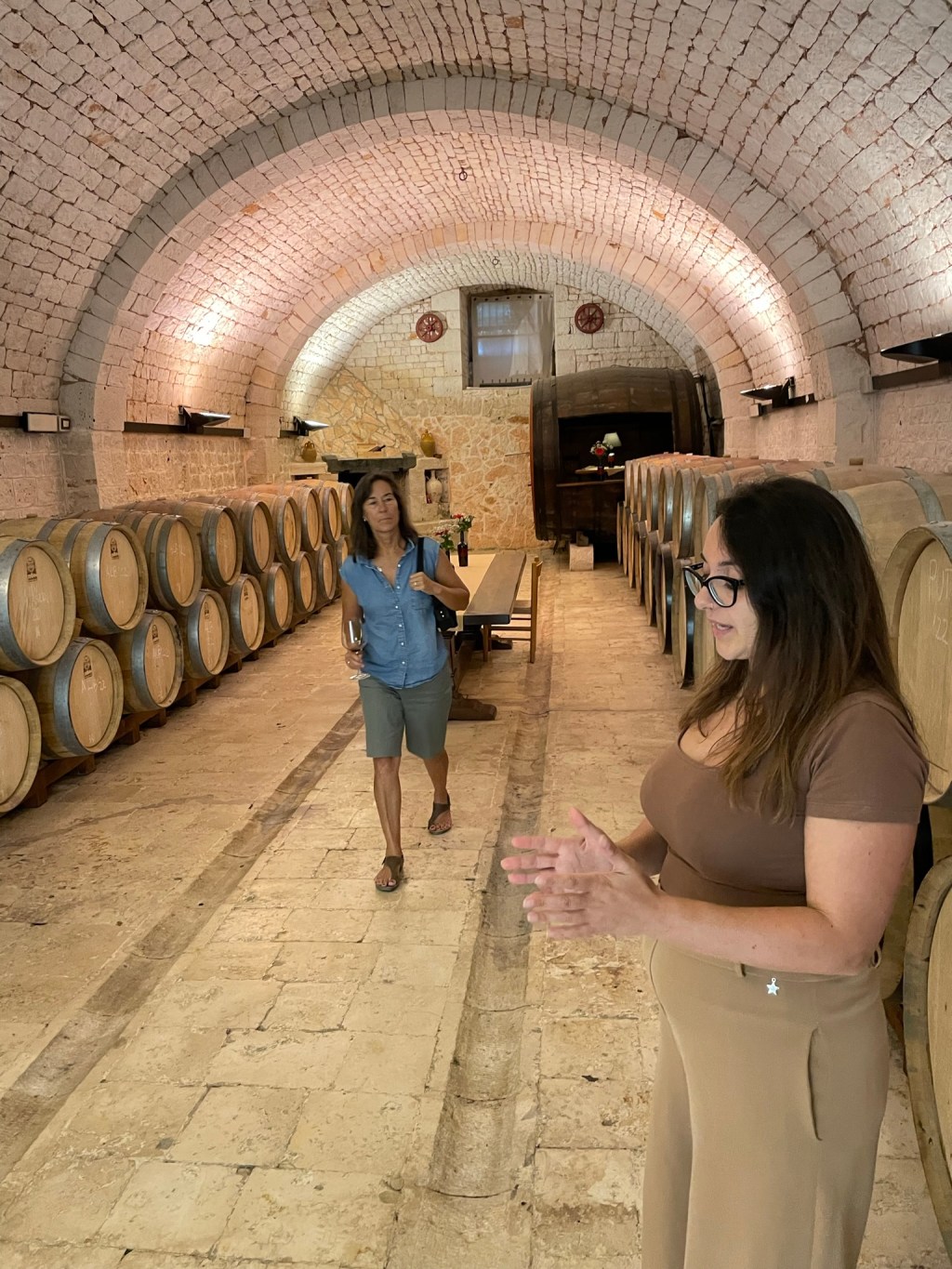
We spent four days in Puglia, IT. Most of our time was spent sightseeing and relaxing at the beach, but we squeezed in a visit to this unique, relatively new winery. They offered pre-scheduled “wine experiences”, with accompanying food, which generally took two hours or more. We had about an hour on the way from our AirBNB in Monopoli to the Bari airport on our last day, and Angelica at the winery agreed to compress our experience into one hour (needless to say, it stretched to almost two hours anyway!). Owner and winemaker Giovanni Aiello happened to be at the winery when we arrived, and he guided us through the production area of the winery, doing both barrel and vat tastings with us. Angelica guided us through tasting of all the currently available bottled wines. All the wines were really good and enjoyable, but three were remarkable:
- 2020 Chakra Rosso–this is 100% primitivo, which is genetically indistinguishable from zinfandel. This wine had some of the familiar aromas and flavors of zinfandel (strong ripe black cherry and blackberry fruitiness, plus that characteristic briary and peppery quality), but had some unusual fruit, too–a tart tamarind aroma, and some savory aromas I just could not place. No real noticeable oak. This wine was dry and light-bodied, which is unusual for a zinfandel. Giovanni fermented this wine from whole-cluster grapes, and left the wine on the lees for extended fermentation. I did not mark the alcohol level of this wine, but it seemed low for a primitivo. This is truly a fresh take on this wine.
- 2022 Chakra Blu–this is a remarkable sparkling wine, made from a blend of verdeca (a wine grape common in Puglia, and almost nowhere else) plus two other grapes I have never heard of, and likely Puglian (maruggio, marchione). The grapes are first fermented conventionally, with the sparkle added by introducing yeast into in the bottle and capping it, like champagne, except that for this wine the lees are left in the bottle. (I think some would call this a pétillant-naturel wine.) I experienced this bottle as two distinct wines. The first was poured gingerly from the carefully opened bottle, and the lees were undisturbed–this wine was clear, crisp, and prosecco-like, with a hint of tart green apple. The second was with the lees mixed back in–this wine was slightly hazy, and still had the crisp and refreshing sparkle, but also had a creamy, brioche quality and a wonderful slick mouthfeel. Two different wines from one bottle was a neat trick!
- 2022 Chakra Verde–this is 100% verdeca, and was absolutely dry, clean and crisp with minimal fruit. I know that there is a debate about the concept of “minerality” in wine, with many knowledgeable sommeliers and winemakers asserting its just not a thing. This wine is a good argument to the contrary, there is no way to not taste a salinity and oyster shell flavor in this wine. In my opinion, this would be an ideal accompaniment to fresh, and especially raw, seafood.
It is a shame that these wines are not exported to the United States. They are great values there (€ 15 to 23, $16 to 25), but the combination of shipping cost and the risks inherent in a private, one-off journey of 6000 miles makes it a non-starter for me. One more reason for a return trip to Puglia!

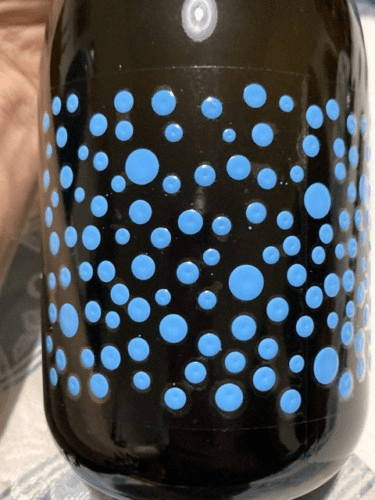
As a sidenote, Giovanni’s wine labels are absolutely unique. They are hand printed, using a block with nails on it, dipped into a special, viscous ink. The dots are raised, and when you hold the bottle, it is hard not to run your fingers over the dots. They also have a very intense color. In the basement of the winery is an room with a table about 30 feet long, used entirely for the hand printing, drying and rolling of the labels. More than anything, the amount of effort and creativity he puts into getting the labels just the way he wants them is a good indication of the passion he brings to winemaking–its no different.
Château de Vaudieu, Châteauneuf-du-Pape, FR
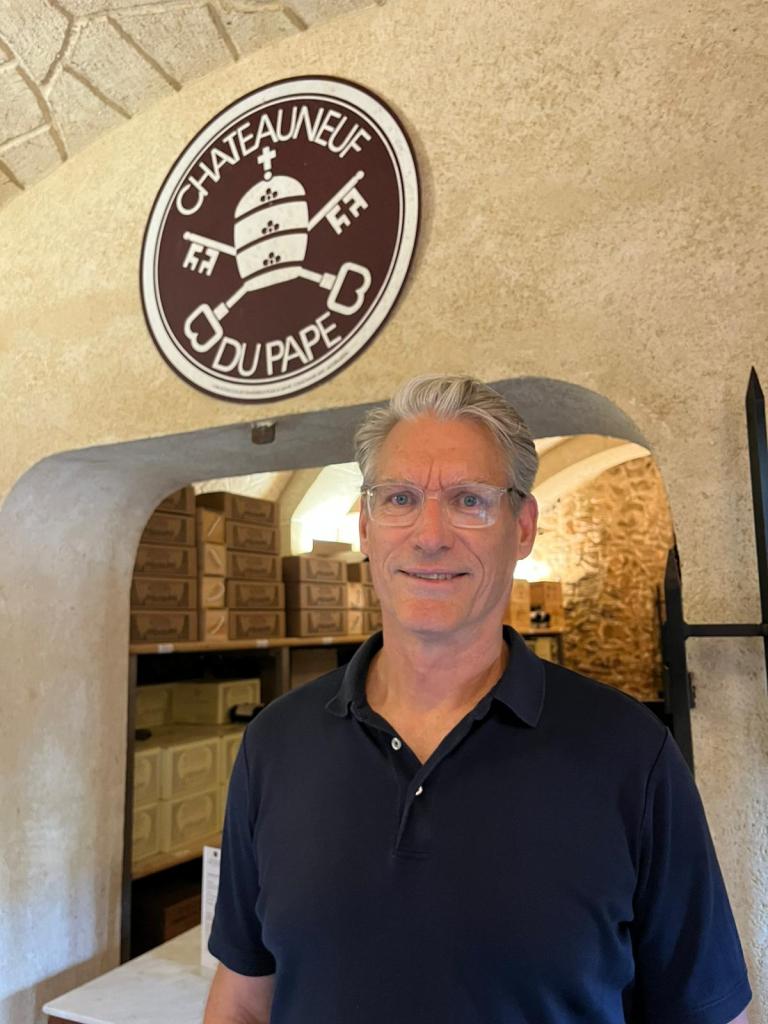
Château de Vaudieu is not the most famous of the wine estates in Châteauneuf-du-Pape–Beaucastel, Télégraphe, Pegau, Janasse and others are all more widely known and more highly regarded, generally. I admit to a sentimental attachment to Vaudieu, because it was the first Rhône wine that knocked my socks off, a couple of years ago. Ever since then, I always have a bottle or two around, and when our travels took us to Avignon, I simply had to visit. The winery was founded in the 18th century, a newbie by French standards. The chateau itself is large and impressive (though a bit under-tended), and is fronted by a park-sized lawn with stately trees. When we arrived, the tasting room was still occupied by the prior group, and we held back for a few minutes until they were done. The guide for our tasting went patiently and methodically through the estate’s current bottlings. We had a fun group, too–Ms. Talented Amateur and myself, our two friends from Avignon, and a couple that randomly joined us (he a Dutchman, she a Brasileira).
It was satisfying, personally, to visit a winery that loomed fairly large in my consciousness and my journey into wine. The wines were very good, but honestly a bit disappointing. Partly this was in the setup: my expectations and hopes ran wild, and I was bound for a bit of disappointment. Also, the wines served at the tasting were all currently available vintages, ranging from 2018 to 2021–most of the Vaudieu wines I had tried on my own, and most that I am holding, are from 2016, an epic vintage. I have some later vintages, but will hold those for some time. The wines served at the winery were young. I did not think to ask about library tasting (i.e. tasting of prior vintages held back for later release by the winery)–that might have been worthwhile. All that said, we tasted some very nice wines:
- 2018 L’Avenue–this is a 100% grenache bottling, from the (you guessed it!) L’Avenue vineyard block on the estate. I got a blast of red fruit (strawberry, cherry), plus a cotton candy aroma (!) and some green herbal aromas. The wine was definitely a bit tight and grippy, and needs a few years.
- 2018 Val de Dieu–with a name like “Valley of God” (again, a vineyard block on the estate), expectations are high, and it sort-of delivered. This is a classic Rhône grenache-syrah-mouvedre blend. It was very well balanced, red fruit & floral aromas, and some oak touches. Again, a bit young and tight.
Olive Oil Tasting at Masseria Salamina, Fasano, IT
If you drive around Puglia like we did for a few days, you will see olive trees in a great variety of shapes and sizes. We later learned some olive trees still in production were over a thousand years old! A four-hundred year old tree in production was actually sort of common. We decided we had to do an olive oil tasting, just to get a better idea of this dimension of Puglia. We made reservations for an olive oil “experience” at Masseria Salamina. A masseria is an estate with a large house or castle, and farm, orchard or vineyard attached to it. Masseria Salamina, like many in Puglia, made ends meet by converting part of the estate house into a hotel, restaurant, and wedding venue.
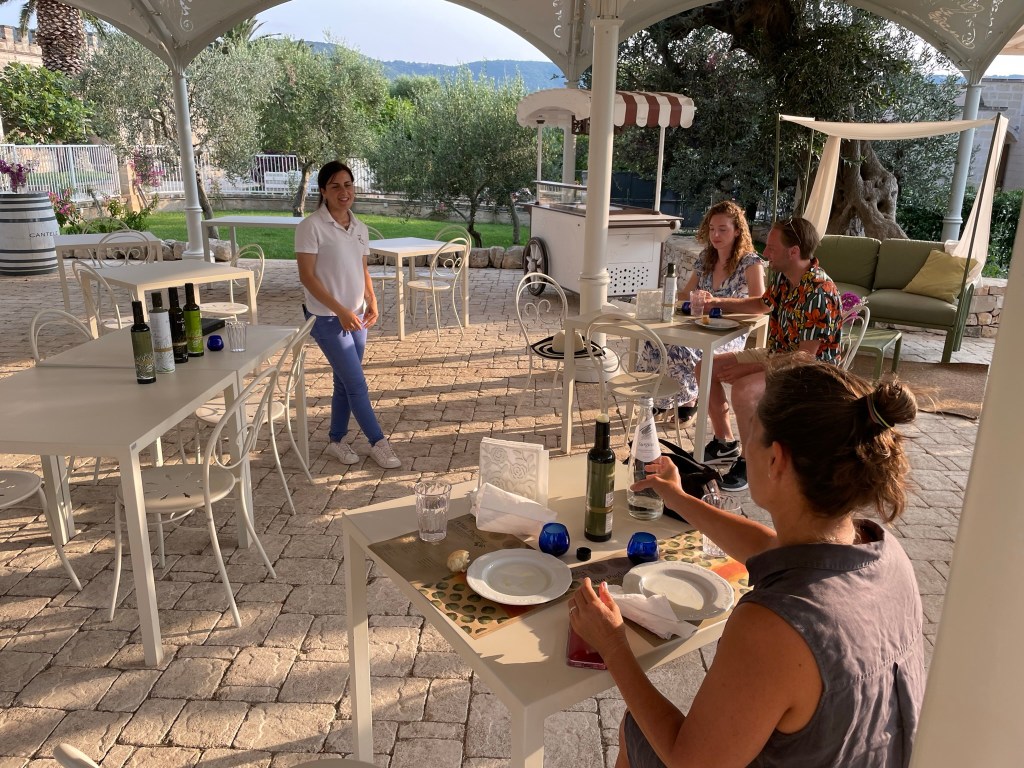
Like the winery visits, this olive tasting experience was almost two hours long, and was heavy on education. It included a tour of the estate house (very impressive!), a tour of the farm and olive orchards, a lesson in olive oil and the various classifications of quality, and a lesson in how to taste olive oil. We were grouped with two other couples, both from the Netherlands. All very interesting and totally worth the time. Some of the more interesting takeaways:
- It is estimated that 70% of the olive oil in the Italian market is fraudulently labeled, with the most common mis-labelings being non-virgin oil labeled as some grade of virgin oil, or simple virgin oil labeled as extra-virgin. I suspect it is at least 70% in the United States, too–there cannot be as much extra virgin olive oil as there is on most supermarket shelves.
- Virgin oil is extracted from the olives without any heat or chemicals. Extra virgin is the highest quality virgin oil, and standards for polyphenol content and characteristics.
- The process of tasting olive oil is somewhat like tasting wine, but with some really important differences. The key characteristics of extra virgin olive oil are not heavily aromatic, as wine is–they are experienced more in the throat than in the nose, as either a bitterness at the very back of the tongue, or a mild burning in the throat. The tasting technique we were taught is not a way of enjoying the oil as much as it is assessing its quality. It was all very, very interesting and Ms. Talented Amateur and I have been trying the techniques with every bottle of oil we encountered after our experience.



 Talented Amateur