In Part 1, I shared my experience of several wines common in Europe, but very hard to find in the US. In this Part 2, I do a deeper dive into two of those wines, and try to find and taste some domestically produced versions of those wines. The purpose of this post is to answer a couple of questions:
1) How do the regional wines I really enjoyed on vacation in Europe taste back home?
2) Are there worthwhile local producers of some of those unusual wines?
The Wines
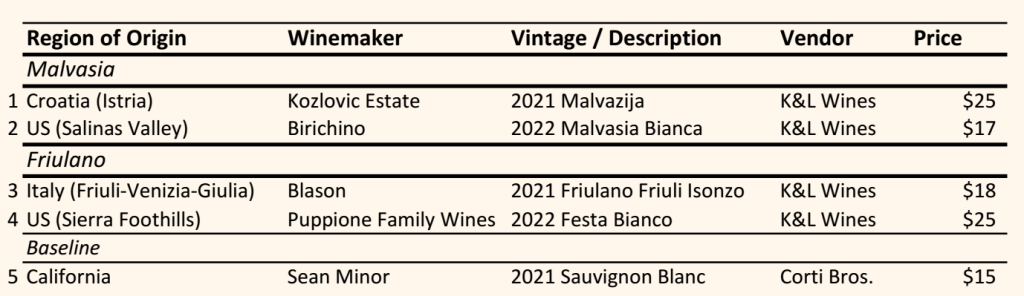
Finding US-produced versions of wines I tried in Italy and Croatia was more difficult than I expected. I tried, and failed, to find them at local brick & mortar retailers. I ended up finding the friulano’s and malvasia’s at K&L Wines in San Francisco (see Post #15 for a comparison of brick & mortar to online retailers). One more familiar wine (a CA sauvignon blanc) was included as a baseline, since few of the tasters had any experience with malvasia or friulano.
The Winemakers
I am profiling only the domestic winemakers, since they are the ones “swimming upstream” in a US white wine market dominated by a very-few varieties. Chardonnay, sauvignon blanc, and pinot grigio account for over 90 percent of the white wine consumed in the US. Producing a wine from grapes almost nobody in the US would recognize, or whose names they could even pronounce, is a bold step, to say the least. I assumed there is a story to these unusual wines produced in the US.
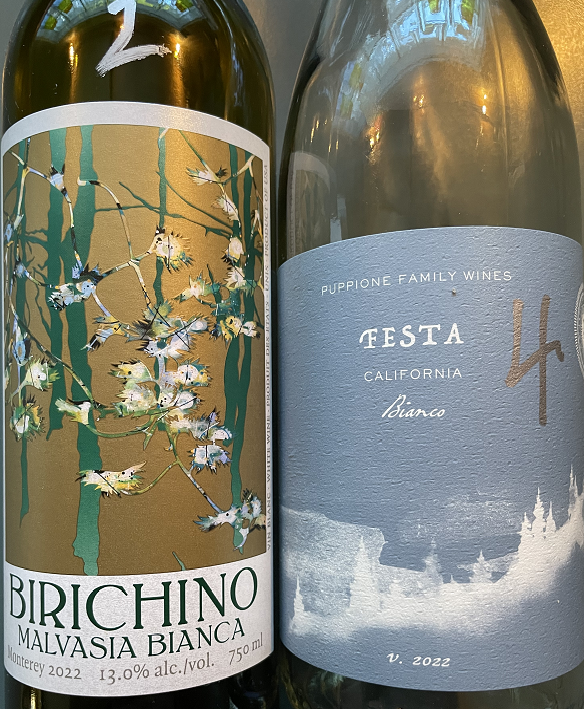
Puppione Family Wine “Festa Bianco” (Friulano)
I talked to Chris Puppione about his family’s choice to make wine from friulano (free-you-lawn-oh) grapes. Like a lot of winemaker stories, this one includes some friends already in the business. Chris has worked in the marketing side of the wine industry for many years, and keeps his “job-job” in the industry. PFW is intentionally small–about 500 cases per year total. Chris and his wife, Dee, want to make wines their way, and also leave room for family life. Soon after starting PFW in 2017, Chris had a yearning to branch out from the syrah-driven red wines he was making and becoming known for, and make a true, Italian-style white wine. A big part of this was honoring his family’s Italian heritage.
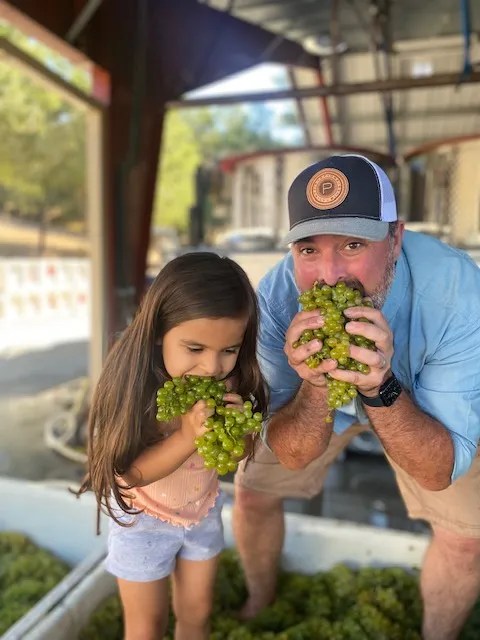
Chris has family ties to Sacramento, and his search for Italian white wine grapes started there. He crossed paths with Ken Musso, who organically farmed a few acres of friulano near Camino, in the Sierra Foothills AVA. Camino shares the hilly topography of Friuli-Venezia-Giulia, where friulano is a dominant grape. That similarity excited Chris. Chris also knew Dan Petroski, founder of Massican Winery, one of the few California winemakers who making quality wines including friulano. (BTW–try the Massican “Annia” blend of friulano, ribolia gialla, and chardonnay). Dan was willing to serve as a lifeline to Chris through the process of making his first friulano vintage. The result was the 2022 Festa Bianco.
Chris views his Festa Bianco as very versatile white wine, due to its mild floral and fruity aromatics, plus its medium-level acidity: “It pairs with everything from a spring salad to thai food.” Chris hopes that versatility wins Festa Bianco a wider audience–just not so wide it takes away from helping his daughter fix that flat on her bike.
Birichino “Malvasia Bianca”

Before Birichino, John Locke and Alex Krause both worked for legendary winemaker Randall Graham at Bonny Doon winery in Santa Cruz. Alex worked on the sales and marketing side, John on the winemaking side. They opened Birichino together in 2008, and malvasia (mall-vah-zee-uh) has a significant place in the winery’s origin story. I caught up with John recently to talk about it. In one of the several transformations of Bonny Doon, malvasia was dropped from their slate of wines in 2005. SAQ, a multi-billion-dollar liquor distributor based in Quebec, was the main customer for the Bonny Doon malvasia, and they wanted to continue buying the wine. John and Alex started Birichino essentially to fill that niche, and for the first two years, Malvasia Bianca for SAQ was the only wine produced by Birichino. That changed quickly. New wines were produced almost as quickly as John and Alex could source new grapes and production capacity, and the Birichino customer base expanded.
Birichino makes a dizzying array of red and white wines from nearly a dozen grape varieties (cabernet sauvignon, pinot noir, zinfandel, cinsault, grenache, carignan, chenin blanc, chardonnay, semillon). But John and Alex do not have a “life list” of wines they are trying to produce–they seek out unique, and sometimes forgotten, vineyards. “We are focused on finding variety and site combinations which will allow a distinctive expression of place, and then applying winemaking methods which will reveal, or certainly not obscure, that expression” says John.
The grapes used for Birichino Malvasia Bianca are grown in the Loma Del Rio vineyard, one of the small blocks within the massive San Bernabe AVA in Salinas Valley. Birichino also makes “pétulant naturel” (mischievous play on “pétillant naturel” or “pet-nat”) versions of malvasia, as well as a skin-contact (orange) version of still malvasia–for those wines they source grapes from the Oasis Vineyard, also within San Bernabe. The choice to use Loma Del Rio for the Malvasia Bianca came down to harvesting technique. John wanted to leave the picked grapes on the skin for at least 12 hours before pressing. Given that 45 tons are needed, hand-picking that quantity, that quickly, is impossible. Loma Del Rio can be machine harvested–that allows for the night harvest, and 12 to 15 hours of skin contact before pressing the following afternoon.
Although some pure commerce had a lot to do with Birichino including malvasia in their slate of wines, malvasia definitely has a special place in John’s winemaking heart: “It’s an immensely malleable grape which you can bend, and classically has been bent, in a number of different ways.”
When I asked John for advice for someone trying Malvasia Bianca for the first time, he suggested a spicy ceviche or shrimp scampi as an ideal pairing. Based on my own Croatian experience with malvazija (the Croatian word for the grape and wine), I would agree 100 percent! Seafood combined with citrus, garlic or almost any spice is a perfect match.
The Tasting
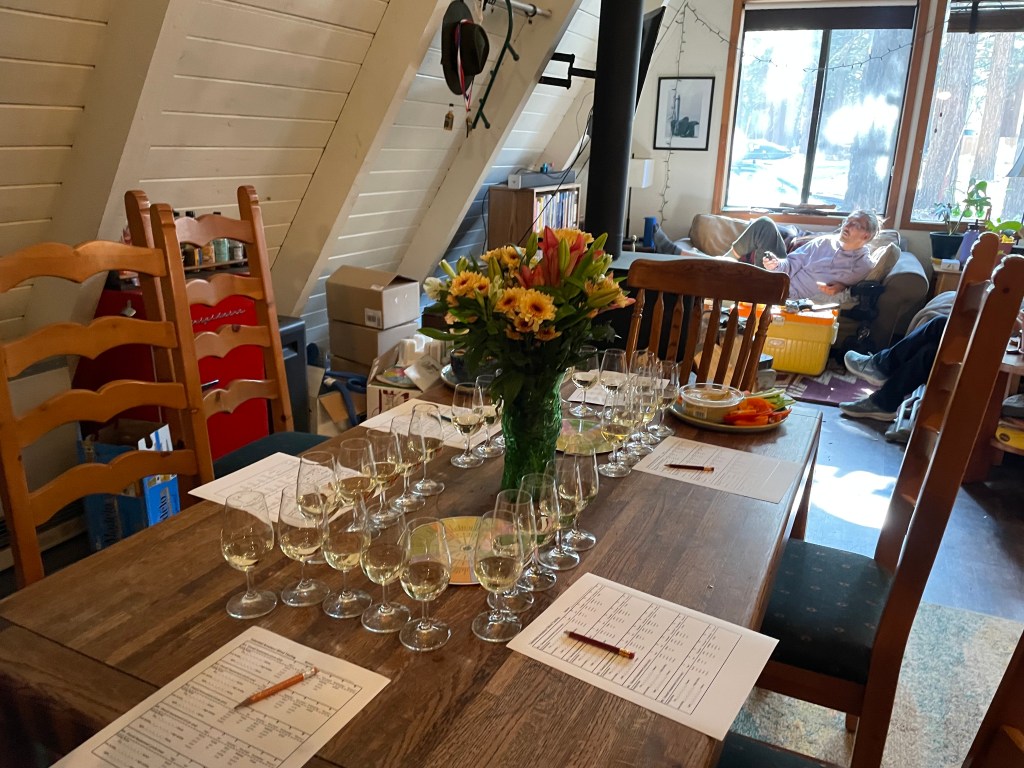
I set up a blind tasting in Mammoth Lakes, CA, to get input from about a dozen subscribers on these wines. The tasting was intended to get overall impressions of the wines, without any bias from seeing a label, pricetag, or winemaker tasting notes. I also wanted to get some feedback on the wine with food (some basic cheese with crackers, and a simple vegetable crudité with spicy humus).
Tasters were asked to try the five wines and give overall impressions before the food was served. Tasters were allowed to modify that first impression after trying the wines with the food. Overall, tasters had about 90 minutes to try the wines and finalize their ratings and notes. Ratings used the simple TA system:
- 1–“Meh”
- 2–“OK”
- 3–“Enjoyable”
- 4–“Very good”
- 5–“Outstanding”
- 6–“Stunner”
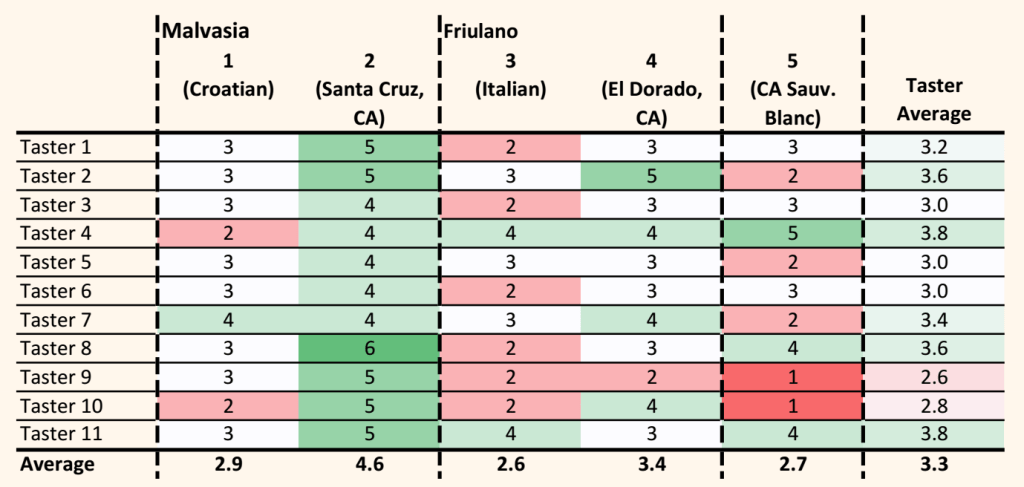
Results are shown below.
Some highlights of the results:
- The Birichino Malvasia Bianca (#2 in the flight) was the runaway favorite of the group, with all tasters rating the wine “very good” or better. This is very unusual for TA blind tastings–most wines have some lovers and some haters. From the tasting notes I read, what captured the tasters’ attention were the aromatics of this wine: lychee, rose, peach were all mentioned multiple times.
- [My tasting notes: I got a lot of those aromatics in my tasting of this wine. The floral notes were really intense and varied–I got rose and jasmine, plus some orange, muscat-y aromas, as well. I noted that the aromas generated an expectation of sweetness in the wine…but it is dry, and that was a delightful surprise.]
- The Puppione Family Festa Bianco (#4 in the flight) was next highest in the ratings, with all but one taster finding the wine “enjoyable” or better. Tasting notes were a bit more mixed, but citrus, floral and mineral (seashell, salt) aromas were all mentioned. One taster listed “sawdust” and “minty lemonade” in notes.
- [My tasting notes: I definitely got the citrus and floral aromas many other tasters noted. I got a hit of jasmine rice aroma, too–that was a first! The strength of this wine is the balance of acidity and fruit, which will match with a wide array of foods–salads, seafood, grilled vegetables, to name a few.]
The Italian and Croatian versions of the wines did not fare as well as the domestically produced versions. The friulano, especially, was so poorly rated I had to check a couple times to see if it was spoiled. For me, it answered the first question for this post: the “vacation effect” was real for me–I enjoyed the wines I tried in Italy and Croatia quite a bit less here at home. Full disclosure: I tried the Kozlovic Malvazija with fantastically fresh or raw seafood, or a white truffle dish, in fantastically beautiful settings on the Istrian coast or hill country; I tried the Blason Friulano in Venice, with a plate of cichetti in front of me. Everything tastes better in conditions like that!
As to the second question of the post, the good news is I found two locally produced wines I thoroughly enjoyed, and neither required shipping across the seas. I will be buying more of both in the coming years. That is a win-win!

 Talented Amateur